
Warner New Materials: Modular Nacelle Covers That Cut Manufacturing Cost by 30%
Wind Power Equipment | Modular nacelle cover design cutting manufacturing cost by over 30%
The large-megawatt problem
Wind turbine power has entered the large-megawatt era. Nacelle cover dimensions keep growing. When "large" becomes the only metric, manufacturing, transport, and cost pressures follow.
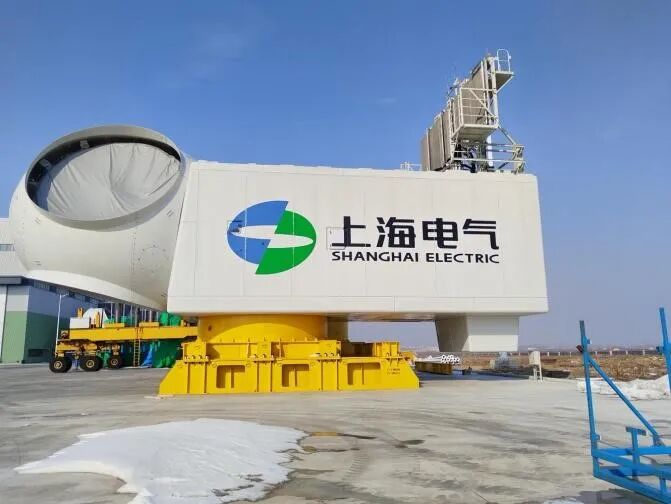
Warner (华纳科技) did not adopt the one-piece molding pathway. It developed a modular approach — breaking the cover into modules — to address efficiency and cost together.
Why modular
Warner's R&D targets modular design and interchangeability for large wind turbine nacelle covers. Instead of manufacturing the cover as a single piece, the company produces separate modules.
The first step addresses large-size manufacturing. Warner uses a split mold plus layered pressure-maintenance process. Resin infusion and layered pressure maintenance are completed under vacuum. Fiber content reaches over 65%, void content is controlled below 0.2%, and overall shell structural strength is reinforced.
Assembly and transport
Modules must be transportable and easy to assemble, not just detachable.
Warner uses topology optimization for module division, with finite element analysis dynamically adjusting module boundaries. A complete nacelle cover is split into 6–8 standard modules.
- How to split: Topology optimization and finite element analysis determine module divisions, reducing weight while maintaining structural integrity.
- How to transport: Split sub-covers are produced and transported separately, avoiding the difficulty of moving oversized complete nacelle covers.
- How to assemble on site: With more modules, assembly precision becomes a requirement. Warner developed multi-model compatible molds and on-site assembly tooling, with adjustable mold cores and modular mold frames enabling six specifications of sub-cover co-line production, reducing duplicate mold investment. Prefabricated flanges and on-site positioning tooling control on-site assembly tolerance within ±2 mm.
Results
Warner developed an integrated "spraying — layup — vacuum infusion" process and multilayer pressure-maintenance technology. Compared with conventional RTM, volatiles are reduced by 60%.
Modular production brings direct efficiency and cost changes: production efficiency up 50%, mold cost down over 30%.
Warner also established a modular classification system. Through functional modules and common interfaces, unit commonality reaches over 70%.
Beyond nacelle covers
Warner's other wind power composite products:
- Nacelle covers and deflectors: Protect internal equipment from wind, rain, salt spray, and UV. Product range covers 2.X–25 MW, over 20 series. Vacuum bag pressing and RTM processes. High strength, stable sealing, controllable wall thickness. Annual capacity 3,500 sets.
- Pultruded plates for wind blade spar caps: Carbon fiber and glass fiber pultruded plates for the blade spar cap load-bearing structure. Continuous pultrusion process. High strength and modulus, fatigue resistance, lightweight, stable mechanical properties. Suitable for large-megawatt onshore and offshore blades, reducing blade weight and improving reliability and service life.
- Melted alloy wear plates: High-wear-resistant steel plates using melting and laser cladding to fuse wear-resistant alloy with carbon steel substrate. High wear resistance, impact resistance, no cracks, bendable. Maximum width over 1,500 mm.
About the exhibitor
Warner is located in Yixing. It manufactures FRP composite materials and environmental equipment. Wind power products supply CRRC and Shanghai Electric. The company holds multiple system certifications, operates a provincial engineering technology research center, and is certified as a high-tech enterprise and “little giant” enterprise. It has undertaken multiple provincial and municipal key R&D projects.
Booth: C1E49
At-a-glance
Warner | Wind Power Equipment | Modular nacelle cover design cutting manufacturing cost by over 30%